|
|
 /
Photovoltaic
/
About
/
Photovoltaic
/
About
|
|
Photovoltaic systems description
|
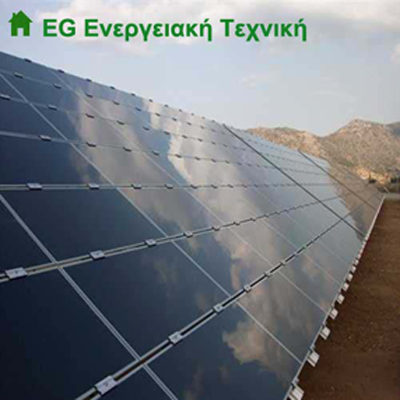 What is a Photovoltaic system?
Photovoltaic systems have the capacity to transform solar power into electric power at a 5-17% rate. This rate varies depending on the selected technology. A typical photovoltaic system consists of the PV panel that constitutes the main part of it or the solar power generator and the electronic systems managing the electric power produced by the PV array. PV systems constitute one of the most rapidly developing RES technologies at a global level.
Where are PV systems applied?
PV systems may be integrated into buildings and appropriate plots, forming a PV park.
The types of photovolatic systems are:
- Monocrystalline silicon
Construction: Made of cells cut from a cylindrical silicon crystal. Efficiency: The PV systems of the highest performance of 14%.
Cost: The highest among the available types due to the complexity in their construction.
- Polycrystalline silicon
Construction: From bars of melted and recrystalised silicon.
Efficiency: Equal to 12% due to the simpler process required for the construction compared to that of mono-crystalline systems.
Cost: Lower than that of mono-crystal systems.
- Amorphous silicon
Construction: Made of a thin layer of silicon put in a uniform way on an appropriate base.
Efficiency: Equal to 6%. Despite the fact that amorphous silica has higher effectiveness in light absorption, its efficiency is lower than that of crystal systems.
Cost: The cost is low. The specific type of panel is ideal for applications not requiring high performances.
*The material is selected based on the need, the space available and the user’s financial capacity.
The Greek Prospect
The PV technology is one of the promising technologies in the renewable energy sector, since the energy saving and the change in the philosophy towards sustainability is the only way.
- PV systems is the most rapidly developing energy sector.
- The cost of the PV technology is gradually decreasing.
- They significantly contribute to the growth of the economy and the creation of new jobs.
- Greece meets all conditions to have a significant domestic production and to become an important energy player in Europe.
- The small systems applied in residences and undertakings are expected to acquire a significant share of the energy market in the future years.
- A significant market share will be held by small producers, since they can provide solutions effectively covering the continuous increase in the energy demand in cases that there is a problem in the security of the supply and no bid investments will be required.
- PV systems have begun to be used also as construction materials on buildings, replacing traditional materials, to achieve energy saving and to reduce the total construction cost.
The architectural market has already made significant innovative progress.
|
Calculate your profit
|
On the table below you can calculate your annual profit, based on the surface of the terrace / roof and the power or fotovoltaic panels:
| Roof surface at an angle (m2) |
8 | 15 | 23 | 30 | 38 | 45 | 53 | 60 | 68 | 75 |
| Terrace surface (m2) |
15 | 30 | 45 | 60 | 75 | 90 | 105 | 120 | 135 | 150 |
| Number of Panels that "fit" |
5 | 10 | 15 | 20 | 25 | 30 | 35 | 40 | 45 | 50 |
| Total power PV (KW) |
1 | 2 | 3 | 4 | 5 | 6 | 7 | 8 | 9 | 10 |
| Annual Energy Production (KWh) |
1,350 | 2,700 | 4,050 | 5,400 | 6,750 | 8,100 | 9,450 | 10,800 | 12,150 | 13,500 |
| Annual Income (€) |
743 | 1,486 | 2,229 | 2,972 | 3,715 | 4,458 | 5,201 | 5,944 | 6,687 | 7,430 |
*The above list is not exhaustive. Those interested should
contact our company to take the economical design that
can be applied to a roof / terraces.

|
|
|
|
Copyright Energy-Greece 2011. All rights reserved. Sitemap Designed and developing by JDIteam.
|